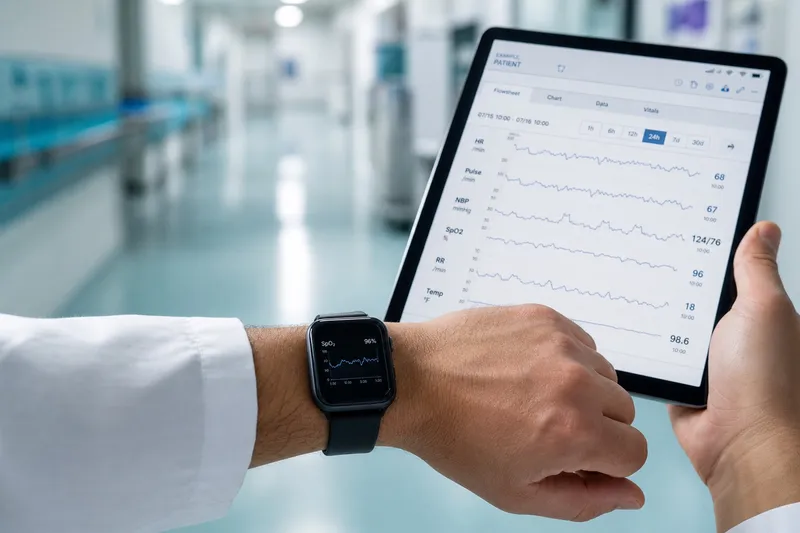
Wearables have absorbed billions in investment over the past decade and produced no consistent improvement in population-level clinical outcomes. David Kirk, chief medical officer of Regard, argues in a published essay that healthcare AI is on track to repeat the mistake unless it learns the underlying lesson: data collection without synthesis does not change outcomes.
Kirk frames clinical insight as a three-layer stack. At the base is longitudinal clinical data — the chart, labs, imaging, medication history. In the middle is the synthesis layer, the actual intelligence that reads the chart and produces something a clinician can act on. At the top, optionally, are wearables: useful as supplementary input, useless on their own.
Wearables fell short, Kirk writes, because vendors built the top layer without the middle one. They harvested physiologic signals but produced no clinician-grade interpretation. The risk for healthcare AI is identical: a generation of tools that add more dashboards, more alerts, more notification cards in the EHR — without doing the synthesis work.
“Clinicians don’t need another dashboard,” Kirk writes. “They need software that reads the longitudinal record and flags what is clinically severe — without making them go look for it.”
His prescription for vendors is operational: build AI that lives natively in the EHR, anchors to the patient’s longitudinal context, and treats the clinician — not the patient, not the administrator — as the user. That framing puts him at odds with much of the consumer-health-AI investor thesis, which assumes the device on the wrist is the platform. From the floor, it usually isn’t.
Source: David Kirk, MD, Chief Medical Officer, Regard, essay on healthcare AI architecture.



Comments
Be the first to comment.
Thanks — your comment is in the queue. An editor reviews comments before they appear. If yours is on point, you'll see it here within a few hours.